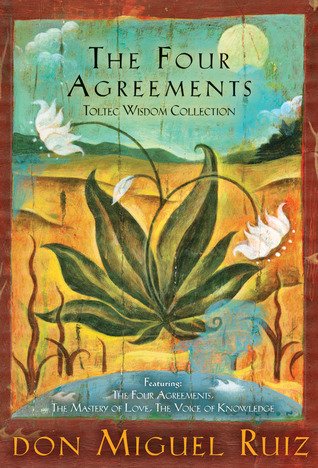
THE FOUR AGREEMENTS
BY DON MIGUEL RUIZ
The Four Agreements is a modern spiritual classic that has touched millions of readers worldwide since its publication in 1997. Written by Mexican author and spiritual teacher Don Miguel Ruiz, the book distils ancient Toltec wisdom into four simple yet powerful principles for living a life of freedom, love, and authenticity. Its blend of psychology, spirituality, and practical guidance makes it a timeless guide for personal transformation.
Overview
At its heart, The Four Agreements is a manual for self-liberation. It challenges the mental and emotional habits that keep us trapped in suffering, self-doubt, and conformity. Drawing on the Toltec tradition—an indigenous Mexican spiritual lineage—Ruiz reframes wisdom in a way that is accessible and immediately applicable to modern life.
The core message of the book is that most of our suffering stems not from external circumstances, but from the way we interpret and react to reality. By adopting four agreements with ourselves, Ruiz argues, we can break the patterns of fear and self-limitation that shape our daily lives.
The Four Agreements
- Be Impeccable with Your Word
Ruiz places extraordinary power in language. Our words shape our inner world and influence those around us. To be impeccable with your word means to speak with integrity, avoid gossip, and refrain from using words to attack yourself or others. This agreement encourages honesty and clarity, reminding readers that what we say has the power to build or destroy.
- Don’t Take Anything Personally
According to Ruiz, nothing others do is because of you; it is a projection of their own reality. When we stop internalizing others’ opinions and reactions, we free ourselves from needless emotional suffering. This agreement invites emotional detachment—not in the sense of indifference, but in the sense of inner peace regardless of external judgment.
- Don’t Make Assumptions
Assumptions are one of the primary sources of conflict and misunderstanding. Ruiz emphasizes that we often create stories in our minds about what others think or intend, which leads to needless stress and resentment. The antidote? Ask questions, communicate clearly, and seek understanding rather than filling in the blanks with fear-based narratives.
- Always Do Your Best
This agreement is perhaps the most compassionate. Ruiz acknowledges that our best will vary from moment to moment—depending on our energy, health, and circumstances—but what matters is the intention to give our fullest effort without self-judgment. Doing your best becomes a path to self-acceptance and growth, rather than a standard for perfection.
Strengths of the Book
One of The Four Agreements’ greatest strengths is its clarity. Ruiz writes with simplicity and directness, making deep ideas accessible to any reader. The principles are presented in a way that is easy to understand yet profound in their potential impact.
The book’s practical orientation is another asset. Instead of abstract metaphysics, Ruiz offers actionable agreements that readers can begin applying immediately. Each agreement can be reflected upon alone, and together they form a cohesive framework for inner transformation.
The spiritual grounding of the book—rooted in the ancient Toltec tradition—adds depth without becoming dogmatic. Whether one approaches the book from a religious, secular, or psychological perspective, there is something universally valuable in its teachings.
Narrative Style and Tone
Ruiz writes in a gentle, encouraging voice, almost like a wise elder guiding the reader. The tone is nonjudgmental and compassionate, inviting readers to examine long-held beliefs without guilt or pressure. This approach makes the book feel personal and intimate, as if a mentor is speaking directly to you.
The narrative includes short explanations, reminders, and reflections that make the book an ideal candidate for ongoing practice rather than a one-time read. Many readers return to its pages repeatedly, using the agreements as daily affirmations or meditation prompts.
Critiques and Considerations
While The Four Agreements has inspired millions, it is not without critics. Some readers may find the Toltec framing unfamiliar or mystical. Others seeking rigorous philosophical or scientific backing may feel the book leans too much on spiritual interpretation rather than empirical analysis.
Additionally, the simplicity that makes the book powerful can also make it seem too basic for readers who want complex psychological frameworks. For some, the agreements may feel like common sense—yet Ruiz’s point is precisely that common sense is rarely practiced consciously.
Ultimately, the book asks readers not for blind belief, but for practical commitment: to observe their thoughts, notice old habits, and slowly replace them with more conscious living.
Impact and Legacy
The Four Agreements has become one of those rare works that transcends its genre. It appears on bestseller lists, is recommended by psychologists and spiritual leaders alike, and has influenced countless personal development programs. Its popularity lies in its universality—everyone struggles with self-criticism, anxiety, and miscommunication, and the agreements offer a pathway out of these patterns.
The message resonates particularly in a world that is increasingly disconnected, overstimulated, and overwhelmed by external pressures. In teaching readers to take responsibility for their inner experience, Ruiz reintroduces a sense of agency and dignity to the practice of living.
Final Thoughts
The Four Agreements is not just a self-help book—it is a guide to conscious living. Its power lies not in complexity, but in its accessible truth: that real freedom begins within. By paying attention to the way we speak, interpret others, make assumptions, and strive in life, we can begin to dismantle the internal barriers that keep us locked in fear and repetition.
Whether you are new to spiritual literature or a seasoned seeker of inner truth, The Four Agreements offers wisdom that is both timeless and transformative. It invites you to look honestly at the stories you tell yourself—and provides a simple but profound set of tools for rewriting them.
~ By Master Mystic